Court of Odd Things
Sole Game Designer
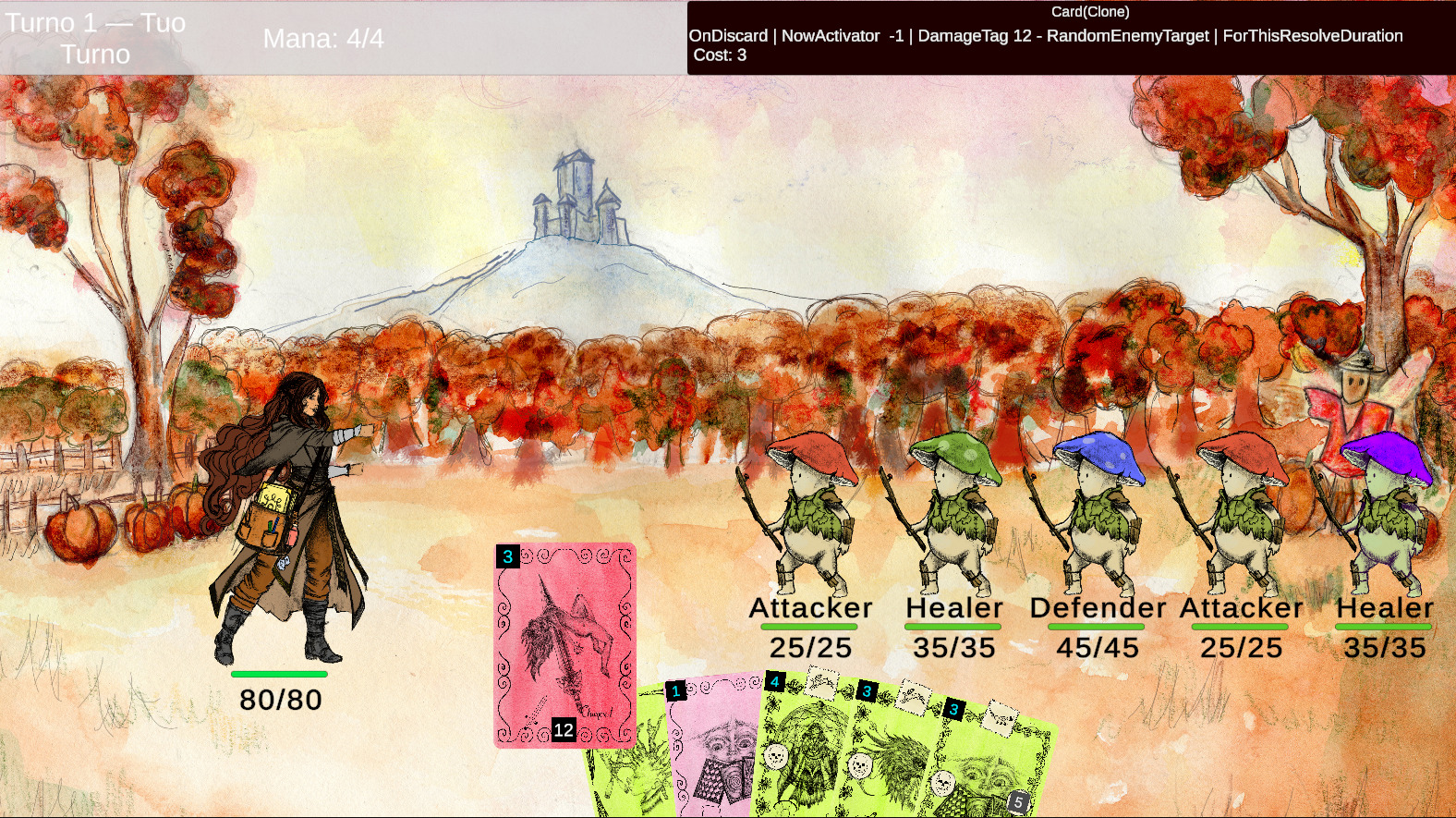
Court of Odd Things is a roguelite deckbuilder where players write their own cards: every card is a sentence built from keywords collected during a run, and enemies play by the same rules. The design goal: "the rules are simple and the same for everyone, but you can bend them."
Price any card the player can write
Problem. With player-made cards, mana costs can't be set by hand.
Decision. Every keyword has a base cost and a Q value, and a card costs the sum of BaseCost + X/Q, all kept in one sheet exported into Unity.
Why it works. Any combination gets a cost, harder-to-trigger keywords get cheaper, and a balance pass is an edit to the sheet.
Read the full breakdown →Let engines be absurd, but finite
Problem. Playtests showed two player-made cards could trigger each other forever.
Decision. An Infinity stat: each card activates at most 3 times per trigger chain, with a global cap of 1024.
Why it works. Loops stay powerful and satisfying, the turn always ends, and the rest of the pile resolves normally.
Read the full breakdown →One rule set for both sides
Problem. Enemies could only use 4 Tags, so most new content only affected the player.
Decision. Every card works for the player and the enemies: Activators watch only their own team, and each Target has a defined meaning for both sides.
Why it works. Every keyword I add is new content for both sides of a fight.
Read the full breakdown →The Phrase System
A card has no fixed effect. It is a sentence with slots, and each slot takes a keyword of the right type:
- Condition. When the card becomes active: when it is drawn, discarded, played or resolved.
- Activator. What triggers its effect, from "now" to "every time Damage is dealt", "every 3 cards you play" or "when your pile resolves".
- Duration. How long the effect lasts: this resolution, this pile, X turns or the whole combat.
- Target. Who the effect hits (see the table below).
- Tag. The effect itself, with an intensity X.
"When this card resolves, every time Damage is dealt, for this pile, gain Block" is one card. Swap the Activator and it becomes a different card. Activators only watch their own side: an enemy's "When Damage" card reacts to damage dealt by enemies, never to the player's. That rule keeps a card's text true no matter who plays it, which matters because enemies draw and play cards from the same system. Every keyword I add is new content for both sides of a fight.
Reading a Card at a Glance
Cards are sentences, so I gave each part of the sentence its own visual layer: the Tag is the main artwork, the Condition sets the background pattern and an icon at the top, and the Activator is the frame. Duration and mana cost have their own symbols, a yellow triangle and a pentagon. A player can read what a card does and when it fires before reading the text.
Targets
The same Target keyword behaves differently depending on who plays it, so one keyword works for both sides:
| Target | Played by the player | Played by an enemy |
|---|---|---|
| Self | The player | That enemy |
| Chosen | A target picked with an arrow; the game pauses until the player picks | The player |
| Fill | All living enemies, value split equally | The player, full value |
| Through | All living enemies, value halved at each next target | The player, full value |
| Random X | X random combatants, player included | X random combatants, player included |
| Safe Random X | A random combatant other than the caster | A random combatant other than the caster |
Tags
The 12 Tags in the current build are Damage, Strike (Damage twice), Block, Shield (Block now and again next turn), Heal, Draw, Discard, Corrupt (the target takes extra damage), Amplify (adds to the next effect, then is consumed), Echo (repeats an earlier effect with the same targets), Burn and Frost. Burn and Frost are a designed pair. Applying one removes the other. Burn deals half its stacks as damage at the start of the target's turn and doubles at the end of every team turn, so it snowballs if left alone. Frost deals 150% of its stacks but loses one stack per team turn, so it hits hard and fades. Each Tag also has a category (offensive, defensive, support or debuff) that sets its color in the UI.
Crafting Cards
Crafting happens in its own menu, opened from the map. The rules are written so that every decision is deliberate and nothing is lost by experimenting:
- Players don't create cards from nothing. They fill empty slots on existing cards or rewrite cards they already own.
- Keywords are stored in an inventory without any value attached. The player sets the intensity X while crafting, and the mana cost updates live with every change.
- Some keywords have slots of their own. "When ___" needs a Tag inside it to know which action to watch, and that Tag is consumed too.
- Until the card is confirmed, keywords are only reserved and can go back to the inventory. On confirmation every keyword used is consumed.
- A card is invalid if its Activator watches the same Tag the card applies ("When Damage, deal Damage"), so a single card can't call itself.
Mana Cost Model
With cards assembled by the player, mana costs can't be set by hand. Each keyword has a base cost and a Q value, and a card costs the sum of BaseCost + X / Q over its keywords, where X is that keyword's intensity. A large Q means intensity is cheap, a small Q means it is expensive, and a negative Q makes a higher value lower the cost, because it makes the card harder to trigger or slower to pay off.
Behind the formula there is a cost table for every Tag at every intensity, which is where most of the balancing happens. Some rows from it:
| Tag | X = 1 | X = 5 | X = 10 | X = 15 |
|---|---|---|---|---|
| Damage | 0 | 1 | 3 | 5 |
| Block | 0 | 1 | 3 | 4 |
| Heal | 4 | 5 | 7 | 9 |
| Corrupt | 1 | 3 | 4 | 6 |
| Amplify | 2 | 5 | 8 | 12 |
| Echo | 5 | 9 | 15 | 20 |
| Draw | 4 | 10 | 18 | 25 |
| Discard | 1 | -2 | -6 | -10 |
Damage and Block are the cheap baseline. Draw and Echo are priced as engine pieces, because extra cards and repeated effects are what make loops possible. Discard turns negative as it grows: throwing away your own cards is a cost, so it pays mana back and becomes a deliberate trade. Activators follow the same logic: "When your pile resolves" costs 2, while "Whenever you draw a card" costs 8, because it can fire many times per turn.
All of this lives in one Google Sheet. One tab holds a row per keyword with everything the game needs: the text fragments the card sentence is assembled from, icon and color, category, shop cost, shard value, unlock cost, level curve, base mana and Q. That tab is exported as card data into Unity, so a balance pass is an edit to the sheet. Another tab is a small "Make a Card cost!" calculator: pick five keywords and their values and it returns the card's mana cost, which I use to test combinations before they exist in the game.
The Infinity Rule
The first playtests found a problem: two player-made cards could call each other forever. "When Damage is dealt, gain Block" and "When Block is gained, deal Damage" create an infinite loop, and the earlier rule that a card can't trigger on its own Tag didn't stop it. I added a player stat called Infinity. Within one chain of triggers, each card can activate at most Infinity times (3 by default), and a global cap of 1024 activations works as a circuit breaker. When the limit is hit, the loop stops and the rest of the pile resolves normally.
The same playtest pass changed other rules. Discarding any card for free made the Discard Tag pointless, and enemies could only use a few Tags (Damage, Heal, Corrupt, Block). From then on, every card and effect has to work for both the player and the enemies, so all content adds interaction on both sides.
Keyword Economy
Rewards after a fight are random keywords and coins. The shop is where players turn that randomness into a plan:
- Buy. The shop has slots for 1 Condition, 1 Activator, 1 Duration, 3 Tags and 3 Targets, each bought with coins. Prices come from the keyword data: "Whenever you draw a card" costs 8, a basic Tag costs 1.
- Reroll. Refreshes every slot, including the ones already bought.
- Unlock. New keywords join the reward pool when unlocked with a second currency that only bosses give: (current world × 25)% of the coins the player holds when the boss dies. Saving coins before a boss pays off, which creates a real spending decision.
- Shard. Unwanted keywords can be recycled into coins, at a value set per keyword. It can't be undone.
Keyword drops after combat are weighted by rarity, from Common to Legendary, with a different distribution for normal fights, elites and bosses, so the designer can tune each one separately.
Map Generation
The map is a set of columns that every path crosses from start to boss. I wrote the generation rules as a spec the programmer could implement directly:
- Every node starts as a fight. Fights are easy in columns 0 to 2, medium in 3 to 6 and hard from 7 on.
- Events: one is guaranteed in the second generated column, and other fights become events with a 22% chance (never in the first column, and never every fight in a column).
- Elites: from column 6 on, each eligible fight becomes an elite with a 16% chance.
- Shops are placed last, converting about 12% of the remaining fights, weighted toward nodes with more outgoing paths so they sit at crossroads.
- Guaranteed nodes: a special event and a crafting node at the start, a gift (pick 1 of 3 keywords) in column 9, another crafting node before the boss, and the boss in the last column.
- Extra branches: side nodes the player can visit and come back from. 3 are guaranteed per map, then each new one has a cumulative 25% chance of being the last, and a branch can't lead to a node of the same type.
When rules collide, a priority order decides which node type wins: special event and boss, then crafting, events, gifts, shops, elites, and plain fights.
Power & Tinker
Raising a card's intensity used to cost mana. I moved that growth into progression: cards now level up with Power, and mana no longer scales with intensity.
- Each card has a level from 0 to 5. The first level costs 3 Power and each next level costs 1.45 times the previous one. Every level adds to the Tag's intensity at a rate set per Tag (Amplify grows by 3 per level, Block by 2), and a Tag can define its own level table where it needs more variety, such as an extra +1 at levels 2 and 4.
- A card keeps its Power when its keywords change. Swapping the Tag recalculates the intensity from the new Tag's curve, and any Power beyond the new maximum goes back to the inventory.
- After every won fight, the Tinker offers up to 3 cards from the deck, each with a Power roll between 3 and 12 on a bell curve, so 5 to 8 is the common result. The player powers up one card, or keeps the average of the three rolls as Power for later.
- Rerolling the offer costs gold, and the price grows exponentially within the same Tinker. The shop also sells Power, with a price that rises with every purchase in the same visit.
The open question I'm testing now is whether putting all Power into one card becomes the dominant strategy. The goal is a game about where to place power, not a stat check, while keeping the satisfaction of watching a card level up. Since players enjoy crossing level thresholds, the upgrade screen highlights them, while still letting players put "a little bit of Power" into a card when a mechanic needs it.
Enemies
Enemies are built from the same cards as the player. Each one has its own deck, draws one card at the start of its team's turn and plays its whole hand, and the order in which enemies add cards to the pile follows their Speed. The current build has four archetypes (attacker, defender, healer and corrupter) across the mushroom enemies, plus larger enemies.
Because enemies play real cards, the player needs to know what is coming. My Enemy Turn Preview spec shows, above each enemy, an icon for the Tag of its next card on a circle colored by Tag category. A card with a Duration gets an outer border that shows which Duration it is: a single dot orbiting the icon for "this pile", a dashed ring with one dash per turn for "X turns", and a thick pulsing ring for "this combat". When an enemy's next card draws more cards, the preview shows the cards it will actually play instead of the Draw icon. Hovering shows the full card, with the values hidden as "???": the player knows what an enemy will do, but not exactly how hard.
For the next content pass I set some rules: elites check whether the player's deck has a certain kind of answer and punish it if not, without being a wall. Bosses are walls: a boss built around healing doesn't instantly kill decks without healing, but beating it without a direct answer takes a very strong deck.
Design Process
Before adding Artifacts (passive items) I wrote a personal checklist that every Artifact has to pass, built on the frameworks from the Mastering Game Systems Design bootcamp:
- Does it fit the game? Check it against the goal stack and the game's mission statement.
- What does it change? It has to change what players want to do, how they feel, or what's on the board, otherwise it's cut. Since enemies use the same rules, ask whether it applies to them too.
- What will players do with it? Assume they play only to win, and treat the Artifact pool as a set of instructions to the player.
- Does it make runs feel different? A good pick has a trade-off, depends on the situation, suits a play style, lasts, and is easy to read. The pool needs both signposts (Artifacts that push one strategy) and hinges (Artifacts that let you switch).
- The numbers. Find the break points, write the balance target first, and find the bottleneck resource.
- Complexity. Learning a rule is paid once, remembering it is paid all run. Anything visible on screen is free, which matters when cards are sentences: if an Artifact changes a rule, the card text should change too.
- How it feels. Players overvalue anything that seems to break the rules, which is almost the definition of this game. Loss aversion, anchoring and the peak-end rule decide how a pick is remembered.
- Testing. Rate every Artifact alone from 1 to 10 and discuss the outliers, test in a late-run snapshot, and try the simplest version first.
One rule came out of it directly: Artifacts should change rules, not just add power. A few common ones can be plain stat boosts, but most should bend a rule of the game, usually in the player's favor.