
Idle Crops Tycoon: Farm & Defend is a hypercasual mobile game that mixes idle farming (in the style of Adventure Capitalist) with lane defense combat. Players grow crops for passive income and spend that income upgrading both the farm and their defenses, and each mode feeds the other. At PowerUP Team I was the sole designer alongside one programmer and one producer. I owned every design decision, the UI implementation, and the IronSource ad integration.
Sole Game Designer and Programmer (team of 3).
Idle games stall once numbers stop feeling new and lane defense has no long-term meta; both modes needed to feel necessary, with an economy that paces 100 levels without quitting.
A dual idle-defense loop where each mode accelerates the other, 6 enemy archetypes (4 variants each), a logarithmic economy, a prestige system, and a rewarded-ad strategy.
Economy built on Kongregate's idle-game math, internal balance passes tuning multiple levers at once, IronSource SDK integration, and a full UI overhaul.
An economy balanced across 100 levels and a projected 2 months of play, with monetization tied to positive moments instead of interruptions. Shipped on mobile.
Responsibilities
- Designed the dual-mode loop linking idle farming and lane defense so progress in one mode speeds up progress in the other.
- Designed 6 enemy types with 4 visual variants each. Every type creates a different tactical priority.
- Balanced the economy across 100 levels and a projected 2 months of playtime, using logarithmic cost curves.
- Designed the prestige system, the weapon and power systems, and the achievement system.
- Designed the ad monetization strategy and integrated the IronSource SDK.
- Programmed the UI and shipped a full visual overhaul during the final polish phase.
The Dual-Mode Loop
Idle games lose players once the novelty of watching numbers go up wears off. Lane defense games on their own have no long-term meta. I wanted a reason for players to keep coming back across sessions, and I wanted both modes to feel necessary instead of having one feel skippable.
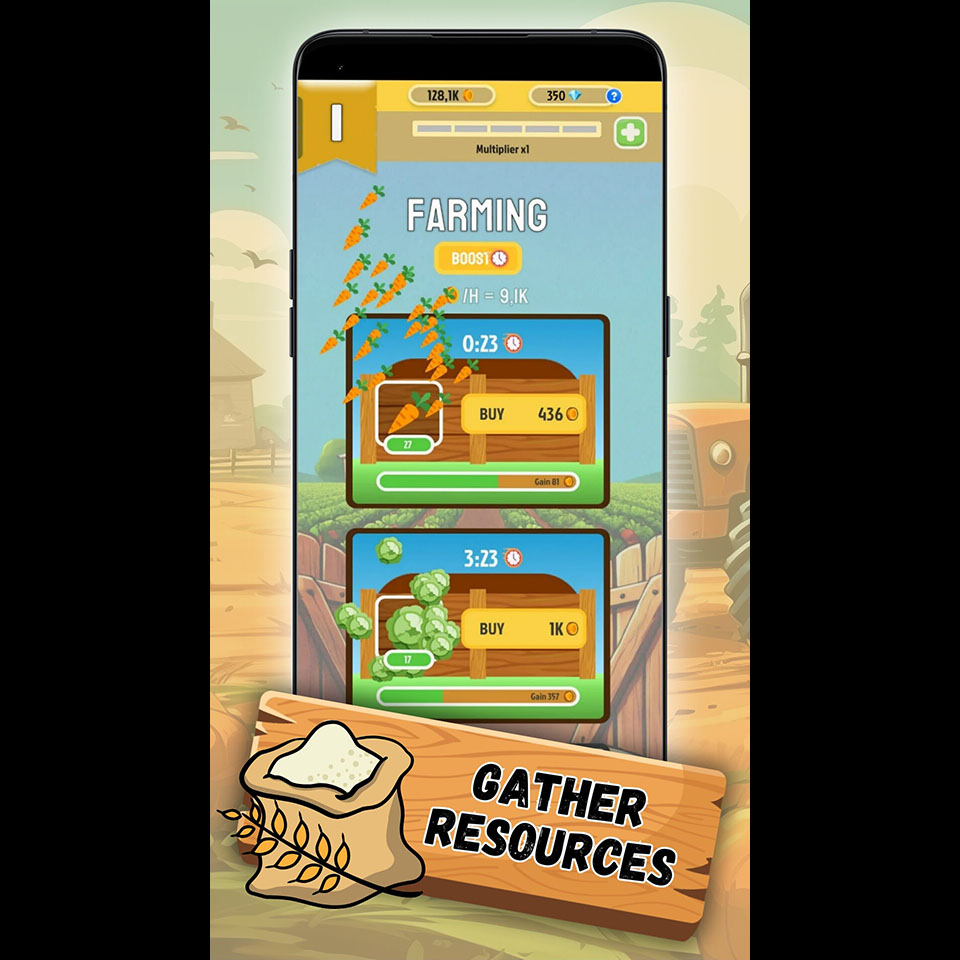
Farm Mode works like Adventure Capitalist. Players buy crops, crops produce gold over time, gold gets reinvested into faster and better crops. Defense Mode is a lane defense shooter where enemies approach in waves. Time spent defending counts as accelerated real-world time for crop progression, so the further you push in defense the bigger your time multiplier becomes. Defense is therefore the fastest way to grow your farm, which gives it a reason to exist beyond being a separate minigame.
Gold earned from farming funds both crop upgrades (more passive income) and defense upgrades (further wave progression, bigger time multipliers). Each mode makes the other more rewarding, which addresses the "why should I play actively" problem common to idle games. Players can let crops run passively, but defending is always more efficient. Defense upgrades are only accessible through farming gold, so neither mode is self-sufficient.
Enemy Design
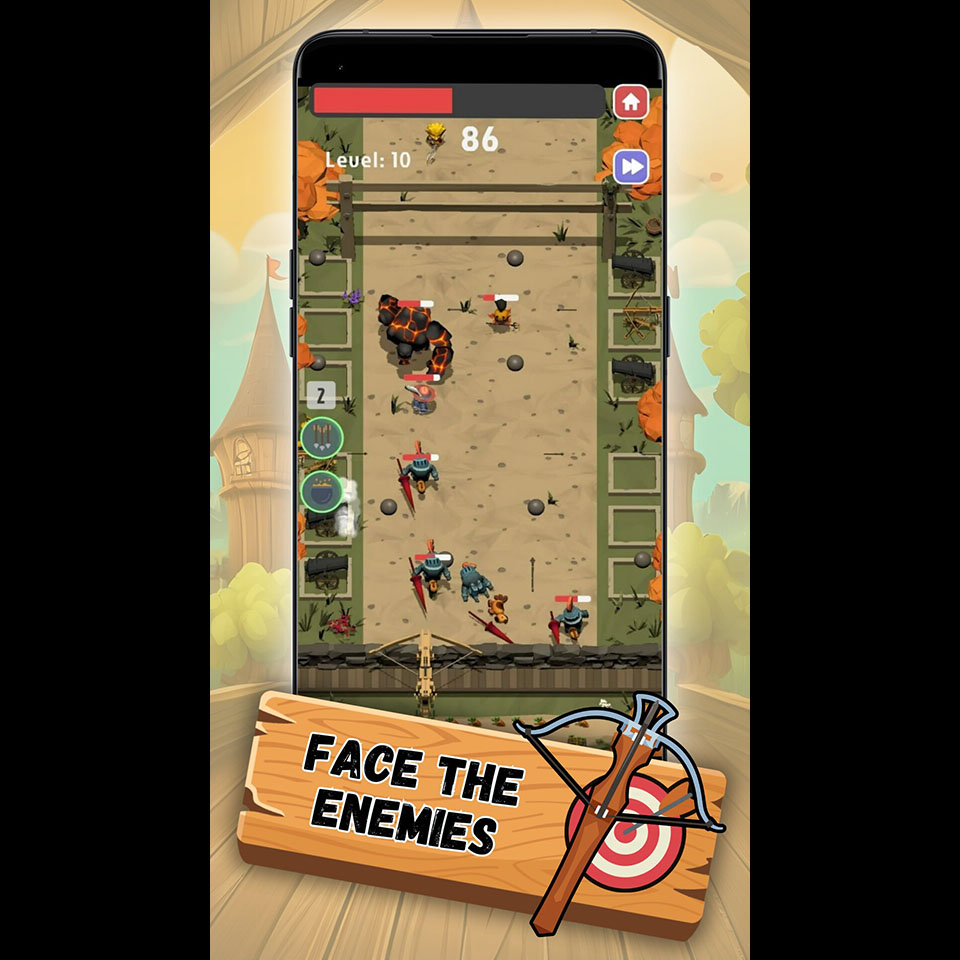
Hypercasual lane defense games tend to ship enemies that only differ in stats (more HP, more damage), which makes later waves feel like early waves but slower. I wanted enemies that create different tactical moments, while keeping the system simple enough for a casual mobile audience. The result was 6 functionally distinct archetypes, each with its own threat profile, plus 4 color variants per enemy for visual difficulty scaling. 24 configurations from a system where each archetype only needs one AI behavior.
| Enemy | Role | Behavior | Design Purpose |
|---|---|---|---|
| Dino | Basic melee | Walks to wall, attacks on contact | Baseline threat. Sets the pace. |
| Goblin | Loot carrier | Moves horizontally across lanes, drops gold on death | Reward target. Tied to ad monetization. |
| Spider | Fast tank | High speed, high HP, low damage | Forces prioritization and power usage. |
| Knight | Elite threat | Very fast, very tanky, medium damage | The "oh no" enemy. Demands resources. |
| Golem | Progression wall | Extremely slow, extremely tanky | Soft skill check. If you can't kill it, upgrade more. |
| Devil | Ranged attacker | Deals damage from distance | Punishes players who only focus on close enemies. |
Each enemy has 4 color variants that show up as waves get harder. The stat bumps come with a clear color shift, so a red Knight reads as more dangerous than a green one before the player even checks the numbers.
Incremental Economy
Incremental games live or die on their economy curve. Too fast and players finish in days, too slow and they quit. I based the economy on published math from Kongregate's postmortem series on Adventure Capitalist (The Math of Idle Games, Parts I and II). The core principle is that upgrade costs scale exponentially while income scales linearly, producing a deceleration curve that feels like progress is slowing but never actually stops.
Crop production timers, payout values, and upgrade costs were balanced around multiples that produce satisfying breakpoints. The idea is that a new upgrade suddenly doubles your income, the game feels fast again, then you settle into the next plateau. Internal testing revealed the initial values were too generous, so I adjusted multiple levers in the same pass:
- Fewer enemies per wave, higher upgrade costs across the board.
- Weaker goblin loot drops. They were making the economy too liquid.
- More HP on spiders, knights, and golems, so later waves felt tankier.
Prestige System
Even with 100 levels and 2 months of content, players eventually hit the ceiling. The game needed a reason to keep playing after they "finished" it, and starting over had to feel exciting instead of punishing. I studied Idle Slayer's prestige system as a reference.
Prestige resets all gold, all crop upgrades, all defense upgrades, and all achievements. In exchange, the player gets Prestige Points based on how many upgrades they owned at the moment of prestige. Prestige Points apply a permanent multiplier to all gold earned going forward, so more points means faster progression through the same 100 levels on the next cycle. The decision of when to prestige is the interesting part. Prestige too early and you don't earn enough points. Prestige too late and you're wasting time in a cycle that already plateaued.
Ad Strategy & Implementation
Free-to-play mobile games need ad revenue to survive, but badly placed ads destroy retention. I wanted ads to feel like a player choice instead of an interruption, so I integrated IronSource's SDK and tied every rewarded ad to a positive gameplay moment.
- Rewarded ads on Goblin kills. When a Goblin drops loot, the player can optionally watch an ad to multiply the drop. The player triggers it; nothing is forced.
- Boost Time ads. Optional ad-watching to temporarily accelerate crop production timers.
- Double Coin at the end of a defense run. The highest-value placement, because the player just spent active time and wants to maximize the return.
- Ad reward cap to stop ad-spamming from breaking the economy.
I handled the IronSource SDK setup myself: configuring the dashboard, hooking up ad networks, and debugging the integration through a few weeks of account approval delays and SDK compatibility issues.
UI Design & Iteration
The first UI worked functionally but looked like a prototype. Pop-ups felt placeholder, buttons had no feedback, the information hierarchy was flat, and the overall visual quality didn't match the gameplay quality. In a mobile market where first impressions decide installs, that was a retention risk we couldn't ship with.
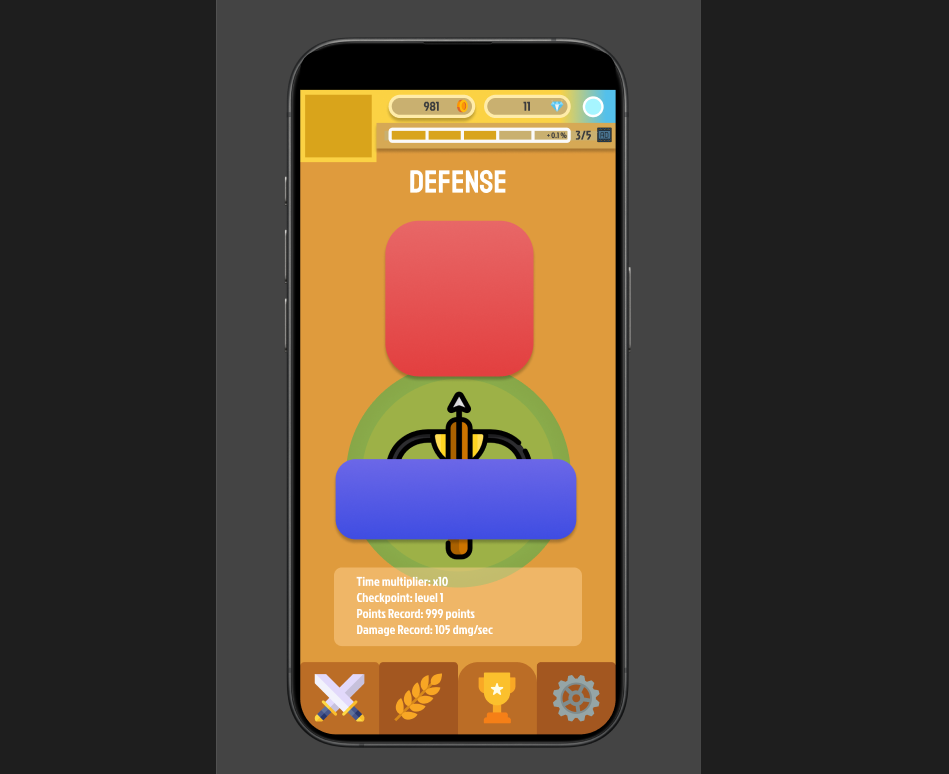
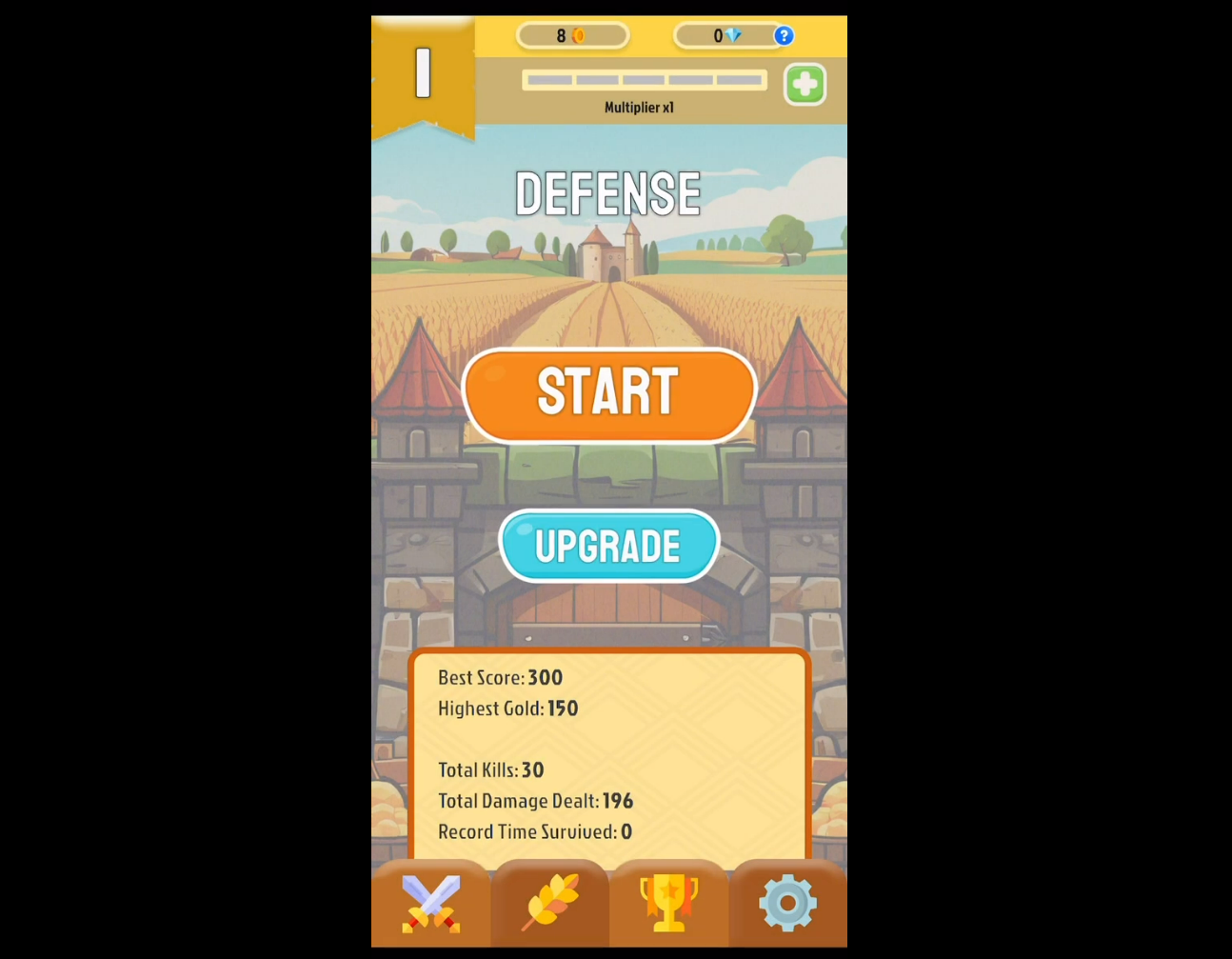
The overhaul touched almost every screen:
- Scale-down/scale-up pulse animations on every interactive button, to match the tactile feel players expect from mobile.
- Reworked pop-ups with patterned backgrounds and consistent styling.
- Swapped placeholder textures for toon-style wood.
- Added claim VFX on achievements and improved the special projectile effect.
- Animated the end-of-battle screen background.
- Restructured the information architecture: icons next to crop timers, "Gain" labels on income bars, a Wall of Fame scoreboard in defense mode.
- Implemented swipe transitions between tabs, taking the idea from Pokémon TCG Pocket.
The team's reaction after the overhaul: "with this background and the UI fixed up like this it already looks like a completely different game."